
What Is Team Software Process? Benefits, Phases & Real-World
Introduction to Team Software Process (TSP)
If you’ve ever worked on a software project where deadlines kept slipping, bugs kept reappearing, and no one could clearly explain why things went wrong, you’re not alone. If you are wondering what is team software process, I’ve been in that exact situation early in my career. We had talented developers, solid ideas, and even good tools, but our results were inconsistent. The real problem wasn’t skill, it was the lack of a structured, team-level process.
That’s where the Team Software Process (TSP) comes in. When people ask what is team software process, I always explain it from real experience. Over the years, I’ve seen how introducing even a simplified version of TSP can transform chaotic teams into predictable, high-performing units. It’s not about adding bureaucracy, it’s about giving teams clarity, ownership, and measurable control over their work.
What Is the Team Software Process (TSP)?
At its core, what is team software process can be defined as a structured framework that helps software teams plan, track, and improve their development process using real data.
But here’s the human side of it.
TSP is not just a process, it’s a discipline system that helps teams stop guessing and start knowing.
Instead of relying on assumptions, teams using TSP:
- Measure their work
- Track defects
- Analyze performance
- Continuously improve
From my experience, the biggest shift happens when teams realize they are not just writing code, they are managing a system. This is the real answer to what is team software process in practice.
How the Team Software Process Works (Step-by-Step Lifecycle)
If you want to understand what is team software process, you need to see how it works in real scenarios.
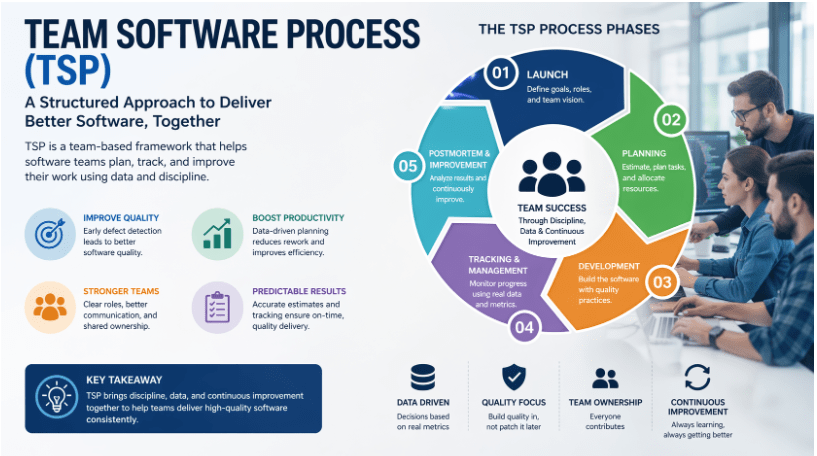
1. Launch Phase
This is where the team sets expectations, roles, and goals. Everyone understands what success looks like.
2. Planning Phase
Work is broken down into manageable tasks, and estimates are made based on historical data, not guesswork.
3. Development Phase
The actual coding begins, but with structured practices like reviews and quality checks built in.
4. Tracking & Management
Teams monitor progress using real metrics such as time, defects, and productivity.
5. Postmortem & Continuous Improvement
After each cycle, the team analyzes results and improves the process.
From experience, this final step is where most growth happens. Teams that skip it stay stuck, and they never fully benefit from what is team software process.
Core Principles Behind TSP
To fully understand what is team software process, you need to look at its core principles.
TSP is built on a few powerful ideas:
- Data over assumptions
- Team ownership over individual silos
- Early defect detection over late fixes
- Continuous improvement over static workflows
These may sound simple, but applying them consistently is what separates average teams from high-performing ones.
What Is Personal Software Process (PSP)?
Before understanding what is team software process is, it’s important to know about the Personal Software Process (PSP).
PSP focuses on improving individual developers by helping them:
- Track their own time
- Measure their defects
- Improve estimation accuracy
I’ve personally used PSP techniques, and one surprising outcome was realizing how much time I was underestimating tasks. That awareness alone improved my delivery reliability.
Difference Between PSP and TSP
Here’s the simple breakdown when comparing PSP and understanding what is team software process:
- PSP equals individual improvement
- TSP equals team improvement
PSP helps developers become disciplined.
TSP scales that discipline across the entire team.
In real-world teams, both work best together.
Why Team Software Process Matters
Understanding what is team software process is important because of the real benefits it delivers.
1. Enhanced Productivity
When teams stop guessing and start planning with data, productivity improves naturally.
2. Fewer Defects and Better Quality
TSP focuses on catching issues early before they become expensive problems.
3. Predictable Project Outcomes
This is huge. Stakeholders care about predictability more than speed.
4. Stronger Team Ownership
Everyone knows their role and contribution.
5. Continuous Improvement Culture
Teams evolve instead of repeating mistakes.
Team Software Process Objectives and Benefits
Improved Software Quality
In one project I worked on, introducing structured reviews reduced production bugs by nearly half within two cycles. This is a practical example of what is team software process in action.
Increased Software Productivity
Better planning means fewer delays and rework.
Enhanced Software Performance
Systems become more stable because quality is built in early.
Strengthened Software Team Collaboration
Clear roles reduce confusion and finger-pointing.
What Are the 4 Core Software Process Activities?
Software Specification
Defining what needs to be built.
Software Design and Implementation
Turning requirements into working code.
Software Validation and Testing
Ensuring the software works correctly.
Software Evolution and Maintenance
Improving and updating the system over time.
These exist in all processes, but TSP makes them measurable and controlled, which is a key part of what is team software process.
Best Practices for Implementing TSP Successfully
From my experience, these are critical when applying what is team software process in real teams:
- Start small, don’t overwhelm the team
- Track meaningful metrics instead of vanity data
- Assign clear roles
- Combine TSP with Agile for flexibility
- Make retrospectives data-driven
Common Myths About Team Software Process (TSP)
- It’s too rigid, only if implemented poorly
- It slows teams down, it actually reduces rework
- Only big companies need it; even small teams benefit
- It replaces Agile, it complements Agile
These misconceptions often stop teams from understanding what a team software process is properly.
Real-World Challenges When Implementing TSP (And How We Solved Them)
Let’s be honest, TSP isn’t easy to adopt.
Pain Point 1: Resistance from Developers
Many developers feel tracking is micromanagement.
What worked for us:
We showed how data helped them, better estimates and less overtime.
Pain Point 2: Too Much Tracking Overhead
Initially, teams feel burdened.
Solution:
We reduced tracking to only critical metrics:
- Time
- Defects
- Task completion
Pain Point 3: Misuse of Metrics
Some managers use metrics to judge individuals unfairly.
Reality:
Metrics should improve the system, not blame people. This is an important part of understanding what is team software process correctly.
TSP vs Agile vs DevOps: What Actually Works Today?
In modern teams, strict TSP alone isn’t enough.
What works best from experience:
- Use Agile for flexibility
- Use TSP for discipline and metrics
- Use DevOps for automation and delivery
This hybrid model creates balance and shows how what is team software process fits into modern development.
Key Metrics Used in Team Software Process (That Most Blogs Miss)
These are the metrics that actually matter when applying what is team software process:
- Defect Density which indicates quality
- Estimation Accuracy which shows planning reliability
- Earned Value for progress tracking
- Productivity Trends for performance over time
In one team I worked with, improving estimation accuracy alone reduced deadline stress significantly.
Personal Opinion (From 10+ Years in the Field)
After working with multiple teams across different industries, I strongly believe TSP is not about strict rules, it’s about awareness.
The biggest mistake teams make is thinking tools or frameworks will fix their problems. In reality, clarity, discipline, and ownership matter more than any methodology.
If implemented with the right mindset, TSP doesn’t slow teams, it frees them from chaos. And that’s something every developer and manager can benefit from when they truly understand what is team software process.
FAQs About Team Software Process
Who developed TSP?
TSP was developed by Watts Humphrey to improve software team performance.
What is the difference between PSP and TSP?
PSP focuses on individuals, while TSP focuses on teams.
Is TSP compatible with Agile?
Yes, and in practice, combining both works best.
How does TSP ensure quality?
By focusing on early defect detection and continuous improvement.
What industries use TSP?
It is widely used in enterprise software, defense, finance, and large-scale systems.
Conclusion
Team Software Process is not just another framework, it is a way to bring structure and predictability to software development. If you are still wondering what team software process is, it is essentially a system that replaces guesswork with data and discipline. In a field where uncertainty is common, having a system that relies on real data and continuous improvement can completely change how teams perform.
From my experience, the biggest benefit of TSP is not just better code, it is better teamwork, clearer expectations, and less stress. When teams know what they are doing, why they are doing it, and how well they are doing it, everything becomes more manageable. And in today’s fast-paced development world, that kind of clarity is a real competitive advantage.

Hi, I’m Ramiz, the founder and editor of EchoGeneral.com
A growing online platform that shares general news, trending insights, lifestyle tips, and informative articles for readers around the world.
My mission is to make knowledge simple, reliable, and accessible to everyone. Through honest reporting and white-hat SEO practices, I aim to build a trusted space where people can explore diverse topics — from technology and health to culture, productivity, and beyond.
📧 Contact: info@echogeneral.com
🌐 Visit: https://echogeneral.com