
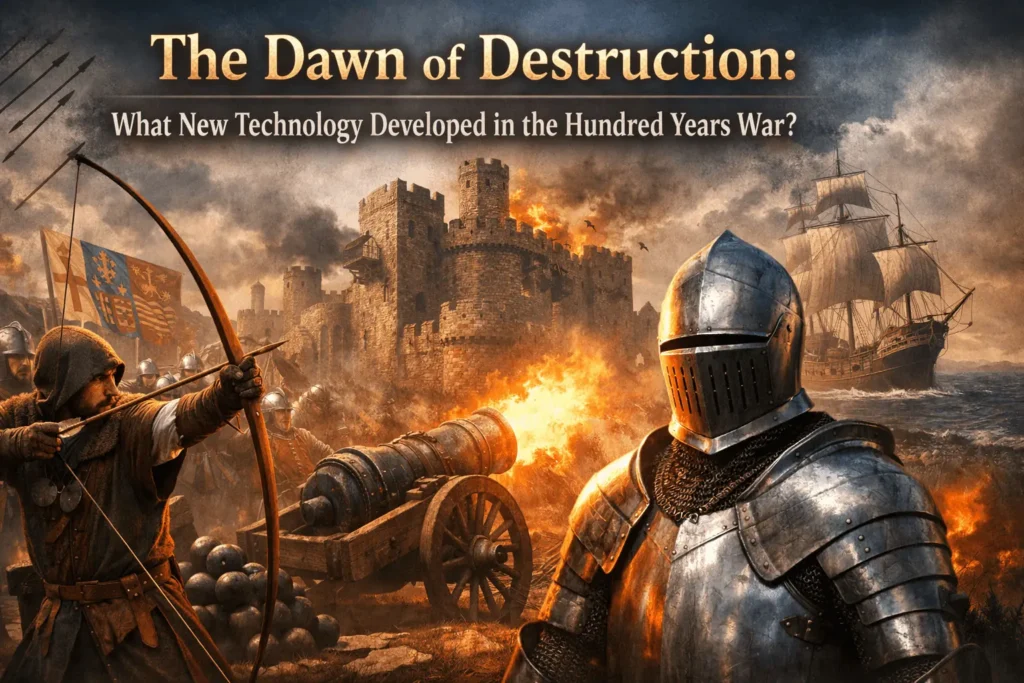
The Hundred Years’ War (1337-1453) between France and England is an event that is generally recalled due to the duration of the war, the mythical battles, and the legends behind the war (Joan of Arc and Henry V). Besides the politics and the heroism, the war was also a tremendous advancement in military technology.
The unskilled learners are incapable of understanding exactly what innovations played a role. Was it but with swords and knights? Or was it the war that brought about technology that changed the fighting field forever? This guide will be done in chronological order of the ways that the Hundred Years’ War transformed warfare. We are going to talk about weapons, armor, guns, ships, and long-term consequences.
The Conflict That Changed Warfare Forever
What the Hundred Years’ War made the Military Technology to be. Wars in the Middle Ages are the subject of popular imagination; people believe that knights fought on horseback. It is a popular myth.
Pain Points Beginners Face:
- Perplexing longbows and crossbows.
- Early awareness of gunpowder was not made.
- Ignoring the development of armor.
- Neglecting the role of strategy and logistics.
You can find out how war changed during this period by examining five key technological changes.
The Game Changers: Archery, Artillery, and Armour
The Reign of the Longbow: Precision and Power
What Was the Longbow?
A longbow was a tall wooden bow, and it was primarily used by the English forces. The people with the skill to shoot could do it more than 200 meters, and they would penetrate solid armor.
Technical Superiority of the Longbow
Why It Was Revolutionary
- Volleys of arrows were made possible through high firing speed.
- Penetration was better by armor than by crossbows.
- Inexpensive in comparison to knights.
- Won over battles like Crécy and Agincourt.
Vital personality: Edward III used longbowmen in order to achieve memorable triumphs.
The English longbow was the most significant weapon in the Hundred Years’ War. It was fast and powerful enough to overcome the knights that were well-armed and transform the medieval war.
Pros & Cons:
- Very efficient and rather economical.
- Years to train to perfection.
- The Bang of Early Cannon: The Introduction of Gunpowder.
Introduction of Gunpowder
The introduction of gunpowder in Europe was in the 14 th century, but it had its origins in China. Warfare was gradually absorbed in its use.
Early Cannons
- Initially, it was mostly used in sieges.
- At first, clumsy and imprecise.
- Caused psychological fear of foes.
Examples: The French troops were increasingly reliant on cannon penetration of English fortifications towards the end of the war.
The Hundred Years war involved the use of gunpowder weapons and the first cannons, which evolved to modern artillery.
Impact:
- Weakened the conventional castle walls.
- Reversed the power of the battlefields on the knights to the artillery.
- Prepared the ground for Renaissance military engineering.
Countering the Threat: Personal Protection Developments
From Mail to Plate: The Evolution of Armour
Why Armor Needed to Change
Classical chainmail could be punctured by longbows and primitive cannons. The soldiers required enhanced security.
Plate Armor
- Full body steel protection
- Better resistance to arrows and early guns.
- Expensive and heavy
Issue: Heavy armor made movement difficult.
Solution: Armorers perfected designs to have protection and movement.
Arguably, the armor developed due to the use of weapons such as longbows and cannons that made the chainmail useless. Plate armor was more effective in safeguarding and survival on the battlefield.
Beyond Land Battles: Naval Innovation and Fortification Changes
Fortifications in Flux: Adapting to Artillery
Artillery vs. Castles
Stone fortifications that used to be regarded as impregnable began to be destroyed by cannons.
Fortification Innovations
- Thicker walls
- Angled towers have been lowered to stop the shooting.
- Early bastion-style designs
These inventions had an impact on military architecture in the Renaissance era.
The Shifting Tides: Naval Developments
Ship Improvements
- Greater logistic transport ships.
- Ships with a longer range. Early carrack-style ships could make longer voyages.
- Improved logistical infrastructure on invasions.
The use of naval control enabled England to make several successful military operations in France.
Emergence of Professional Armies and Military Government
It was not just technology that won wars, but organization was also important.
Structural Changes
- Regular armies became crown-paid.
- Soldiers were specifically trained to deal with new weapons.
- There was an improvement in logistics and supply lines.
Figure: Edward III introduced professional soldiers into the army of England. This decreased the influence of feudal knights and transformed the way of war.
Uncommon Misconceptions regarding Technology in the Hundred Years’ War
- Believing that longbows were new (they had existed earlier, but of enormous proportions)
- As cannons had been extremely accurate initially.
- Never mind the economic effect of weapon innovation.
- Ignoring leadership and morale as components of military success.
Best Practices in Studying Military Technology
No, by the event, you are a pupil, a writer of books, or an amateur of antiquities:
Step-by-Step Guide:
- Timetables of major battle studies.
- Visual comparison of weapons.
- Link technology changes and battle results.
- Compare leadership decisions and technology.
Tools & Resources:
- The interactive battle maps of history.
- The documentaries on the war in the Middle Ages.
- Artillery and armor textbooks.
- Learning history software.
Internal link suggestions:
- “Medieval Warfare Explained”
- Effects of gunpowder in Europe.
- “Feudal Military Systems”
Long-Term Impact
The Hundred Years’ War made permanent alterations:
- Farewell to knights and heavy cavalry.
- Emergence of ground and gun supremacy.
- Unified armies and enhanced army logistics.
- The early development of modern European warfare.
These changes affected centuries of wars, from the Italian Wars to the Renaissance era.
Conclusion
The Hundred Years’ War was not just a protracted political battle. It became a milestone in the history of the military. The English longbow and early gunpowder cannons, plate armor, and siege inventions brought a new face to the European war permanently.
When creating learning material, studying to pass exams, or developing a history-based website, it is important to get familiar with these technological developments. Enhance your history content and credibility by finding more of our related guides or having a free audit.
Learn about: Braves Marcell Ozuna Waiver Candidate explained.
FAQs
What was the innovation of the Hundred Years war?
All the inventions were the use of better fortifications, plate armour, gunpowder, and the use of the English longbow.
And was it the inferiority of the cross-bow to the long-bows?
Yes. It was also quicker and more efficient at a distance, but it required a long time of practice at the practice field.
Did gunpowder conquer the Hundred Years’ War?
Guns helped France to rejoin the ground, indirectly, in storming fortifications.
How did technology affect the knights?
Longbows and cannons made the heavy cavalry unable to gain the upper hand on the battlefield.
What was the history of the Hundred Years’ War to the cause of the war?
It was the start of the period of the feudal revolution of warfare to the technology-based and centralized armies.

Hi, I’m Ramiz, the founder and editor of EchoGeneral.com
A growing online platform that shares general news, trending insights, lifestyle tips, and informative articles for readers around the world.
My mission is to make knowledge simple, reliable, and accessible to everyone. Through honest reporting and white-hat SEO practices, I aim to build a trusted space where people can explore diverse topics — from technology and health to culture, productivity, and beyond.
📧 Contact: info@echogeneral.com
🌐 Visit: https://echogeneral.com