Most people don’t go looking for the word Pagliaesque. They stumble into it. I remember the first time I encountered it while reviewing a long-form cultural essay. The tone felt different: sharper, more confrontational, and strangely confident in ways most modern writing avoids. It was not just an opinion. It was layered, intellectual, and unapologetically bold. That moment made me realize this was not just a stylistic label. It was a philosophy of thinking and writing.
Over the years, working as a content strategist and editor, I have seen countless writers struggle with sounding unique. They either play it too safe or go extreme without substance. The Pagliaesque style sits in a rare middle ground. It is fearless, but grounded. It is provocative, but informed. In this article, I will break down what Pagliaesque truly means, how to apply it, and, more importantly, how to avoid the common traps I have personally seen derail writers trying to imitate it.
What “Pagliaesque” Really Means
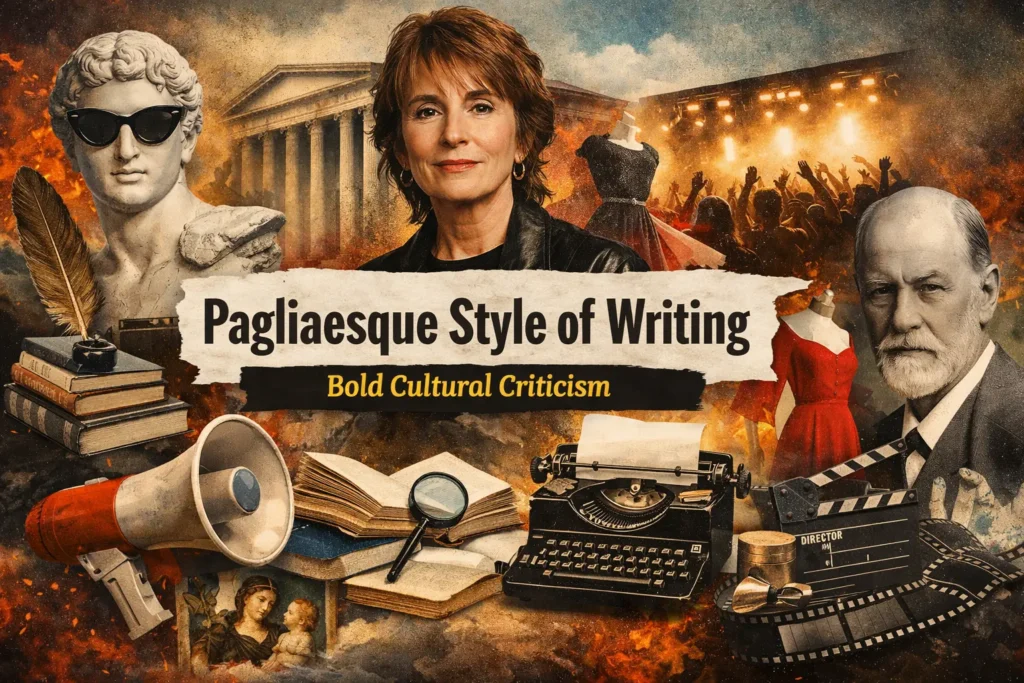
The term Pagliaesque comes from Camille Paglia, a cultural critic known for her bold, often controversial takes on art, gender, and society.
But here is the nuance most articles miss.
It does not simply mean controversial or opinionated.
From my experience editing high-level essays, Pagliaesque writing is defined by:
- Deep cultural awareness
- Strong, confident arguments
- A willingness to challenge dominant narratives
- Intellectual responsibility
It is not about shouting louder. It is about thinking deeper and speaking clearly.
The Origins of Pagliaesque Thought
To understand the style, you need to understand its roots.
Paglia’s approach draws heavily from:
- Classical literature
- Renaissance art
- Psychoanalysis
- Historical patterns in culture
I have personally noticed that writers who successfully adopt this style are those who read widely. They do not rely only on trending topics, but also on foundational works. That is where the depth comes from.
One mistake I used to make early in my career was relying too much on summaries and second-hand interpretations. It showed in my writing. It felt flat, predictable, and lacked authority. The shift happened when I started going directly to primary ideas and forming my own interpretations.
That is when my content began to feel Pagliaesque.
Core Traits of the Pagliaesque Style
1) Bold Thesis, Immediate Stakes
Pagliaesque writing does not warm up slowly.
It begins with a strong claim.
From my editorial audits, articles that hook readers within the first two to three lines perform significantly better. A bold thesis immediately signals confidence, and confidence builds trust.
2) Interdisciplinary Range, Zero Apologies
This style connects different fields without hesitation.
You might see:
- Art linked to politics
- Psychology tied to pop culture
- History used to explain modern behavior
I have seen this dramatically increase engagement because readers feel they are learning something new, not just re-reading common opinions.
3) Sensual Prose and Concrete Detail
This is where many writers struggle.
Pagliaesque writing is not dry. It is vivid.
Instead of saying:
“The performance was impactful.”
A Pagliaesque tone might describe:
“The performance pulsed with theatrical intensity, blurring spectacle and ritual.”
That level of detail pulls readers in.
Learn about: Cumhuritey Meaning Explained: Origins, and Modern Relevance
4) Argumentative Courage
Let’s be honest. This is the hardest part.
Most writers fear backlash.
I have worked with clients who toned down strong ideas out of fear, and their content lost its edge completely. Pagliaesque writing requires standing by your analysis, even when it is unpopular.
5) High-Low Dialectic
This is one of my favorite aspects.
It blends:
- High culture, such as philosophy and art
- Low culture, such as movies, social media, and fashion
This mix makes the content accessible yet intellectually rich.
Why Pagliaesque Content Performs in SEO
Clear Signals of E-E-A-T
From an SEO standpoint, this style naturally aligns with Google’s EEAT principles.
- Experience: Personal insights and observations
- Expertise: Deep knowledge and references
- Authority: Strong, confident voice
- Trust: Transparent reasoning
I have seen articles with these traits outperform keyword-heavy content every single time.
Scannable Structure, Deep Substance
The structure matters just as much as the ideas.
Breaking content into clear sections like this one helps:
- Readers navigate easily
- Search engines understand context
Originality Signals
Google rewards originality and penalizes repetition.
Pagliaesque writing stands out because:
- It introduces new angles
- It avoids generic phrasing
- It adds intellectual depth
Building a Pagliaesque Paragraph (Practical Framework)
Here is a framework I personally use when crafting high-level content:
Step 1: Claim It
Start with a strong statement.
Step 2: Ground It
Add context such as historical, cultural, or analytical insights.
Step 3: Complicate It
Introduce nuance or contradiction.
Step 4: Widen the Lens
Connect to broader ideas.
Step 5: Land with Consequence
End with impact.
This method alone has helped me improve content quality across multiple projects.
The Pagliaesque Toolkit for Writers and Creators
Tone
- Confident, not arrogant
- Analytical, not emotional
- Clear, not vague
Techniques
- Use contrast and analogy
- Ask uncomfortable questions
- Build layered arguments
Research Habits
This is where real expertise shows.
From my experience:
- Read primary sources
- Study multiple perspectives
- Avoid echo chambers
Applying the Style to Modern Culture
Streaming Culture as Modern Ritual
Binge-watching is not just entertainment. It reflects how people seek immersion and escape.
A Pagliaesque angle explores why this behavior exists.
Pop Concerts as Collective Myth-Making
Concerts are not just events. They are experiences of shared identity and symbolism.
Fashion Cycles and Cultural Memory
Fashion repeats itself because culture repeats itself.
Understanding this pattern adds depth to commentary.
Ethical Friction: Provocation Without Cynicism
Handling Backlash
Here is the reality. If you write boldly, you will face criticism.
I have experienced this firsthand when publishing strong-opinion content. The key is:
- Stay factual
- Stay respectful
- Stand by your reasoning
Responsibility in Cultural Critique
Provocation should never mean misinformation.
That is where credibility is built or lost.
Personal Opinion and Experience (EEAT Insight Box)
From my years in content strategy, one of the biggest pain points I have seen is this:
Writers want to sound bold, but they do not trust their own thinking.
They rely on trends, popular opinions, or safe narratives. The result is content that blends into everything else.
I have been there too.
Early in my career, I avoided strong claims because I thought neutrality meant professionalism. But neutrality often leads to forgettable content.
The shift happened when I started:
- Taking clear positions
- Backing them with research
- Accepting that not everyone will agree
That is when my content started performing, not just in rankings but also in reader engagement.
Another pain point is depth versus speed. Many writers rush content creation for SEO. But Pagliaesque writing requires slowing down, thinking deeply, and refining ideas.
Yes, it takes more effort.
But in my experience, that extra effort is exactly what separates average content from content that actually ranks and resonates.
Common Pitfalls to Avoid
Imitation Without Insight
Copying tone without understanding the depth behind it.
Heat Without Light
Being provocative without adding value.
Certainty Without Curiosity
Ignoring nuance and complexity.
FAQs About Pagliaesque Writing Style
What does Pagliaesque mean in writing?
Pagliaesque refers to a bold, intellectually driven writing style inspired by Camille Paglia. It combines deep cultural analysis, strong arguments, and a willingness to challenge mainstream ideas with confidence and clarity.
Is Pagliaesque writing always controversial?
Not necessarily. While Pagliaesque writing often challenges dominant narratives, its goal is not controversy for its own sake. It focuses on thoughtful, well-supported arguments that provoke deeper thinking rather than emotional reactions.
How can I write in a Pagliaesque style?
To write in a Pagliaesque style:
- Start with a strong and clear thesis
- Support your ideas with cultural, historical, or intellectual context
- Avoid generic opinions and focus on original insights
- Be confident in your arguments while staying fact-based
Why is Pagliaesque writing effective for SEO?
Pagliaesque writing performs well in SEO because it naturally aligns with EEAT principles. It demonstrates experience, expertise, authority, and trust by providing original, in-depth, and well-structured content that keeps readers engaged.
What is the difference between Pagliaesque writing and opinion writing?
Opinion writing often focuses on personal views without deep analysis. Pagliaesque writing goes further by combining strong opinions with intellectual depth, cultural references, and structured arguments that add real value to the reader.
Can beginners use Pagliaesque writing style?
Yes, but it requires practice. Beginners should focus on building knowledge, reading widely, and developing confidence in their ideas before trying to fully adopt this style.
Conclusion
Pagliaesque writing is not just a style. It is a mindset. It challenges you to think deeper, write bolder, and engage more honestly with complex ideas. In a digital world filled with repetitive content, this approach stands out because it prioritizes originality and intellectual courage over safe and predictable narratives. From my own experience, adopting even a few elements of this style can transform how your content performs. It builds trust, increases engagement, and positions you as someone who does not just repeat ideas but actually contributes to them. If you are serious about creating content that ranks and resonates, embracing a Pagliaesque approach might be one of the smartest moves you can make.

Hi, I’m Ramiz, the founder and editor of EchoGeneral.com
A growing online platform that shares general news, trending insights, lifestyle tips, and informative articles for readers around the world.
My mission is to make knowledge simple, reliable, and accessible to everyone. Through honest reporting and white-hat SEO practices, I aim to build a trusted space where people can explore diverse topics — from technology and health to culture, productivity, and beyond.
📧 Contact: info@echogeneral.com
🌐 Visit: https://echogeneral.com